Pull a heavy day into numbered parts, then put it back in order
Open almost any parts catalog to its back pages and you meet an odd kind of picture. A water pump or a wheel hub floats on the page in pieces, each part slid a short way from its neighbor along an invisible line, each one marked with a small number inside a circle.
Draftsmen call that picture an exploded view, and nothing in it is broken. The drawing only moves the parts apart so a person can see what is there, which way each piece travels and in what order the whole thing goes back together.
A full day can be drawn the same way. Most of us carry our days as one solid lump: the errands, the call to the insurance office, the gift that still needs wrapping, the gutter over the back door. Carried like that, the lump weighs more than its parts, and it is easy to set one piece down somewhere and only notice at bedtime. The habit on this sheet borrows the catalog's trick. It costs a pencil and one page, and it tends to leave the head clearer by the middle of the afternoon.
What the drawing actually does
An exploded view does three jobs at once. It shows every part, including the small ones that hide inside an assembly, like the thin washer tucked under a nut. It shows direction, because the parts are pulled apart along the same axis they slide back onto. And it shows sequence: part one goes on first, part six goes on last. Carry those three jobs over to a Tuesday and you get a plain method. Name every piece of the work, decide which way each piece moves, and number them in the order they will really happen.
People who handle complicated work for a living have relied on versions of this for decades. Pilots read a written checklist aloud even on routes they have flown hundreds of times. Nurses chart each step rather than trusting recall across a long shift. The reason is not weak memory. Writing a sequence down hands the bookkeeping to the paper, so attention can stay on the piece in your hands.
Set the whole assembly on the bench
Before taking anything apart, write the entire job as one line across the top of the page. "Get the house ready for my sister on Friday." "Sort out the car registration." One line, plain words. This is the assembly as it looks in its box. It earns its place later: when you are deep among the small pieces, a glance at the top line reminds you what all of them are for.
Slide the pieces away from each other
Under the top line, list every separate piece of work the job contains, without worrying yet about order. For the visit: wash the guest sheets, clear the spare-room desk, buy coffee filters, move the car so she can park, test the porch light. Keep listing until each line is something you could finish in a single sitting without stopping to decide anything new. If a line still has a decision buried inside it, it is not one part. It is a smaller assembly, and it gets pulled apart again on its own line.
This is where the hidden washers turn up. Nearly every stalled job has one: the phone number you need before you can call, the receipt you must find before you can file. Writing the pieces out drags those small parts into daylight, where they stop ambushing you halfway through.
Give every piece a circle and a number
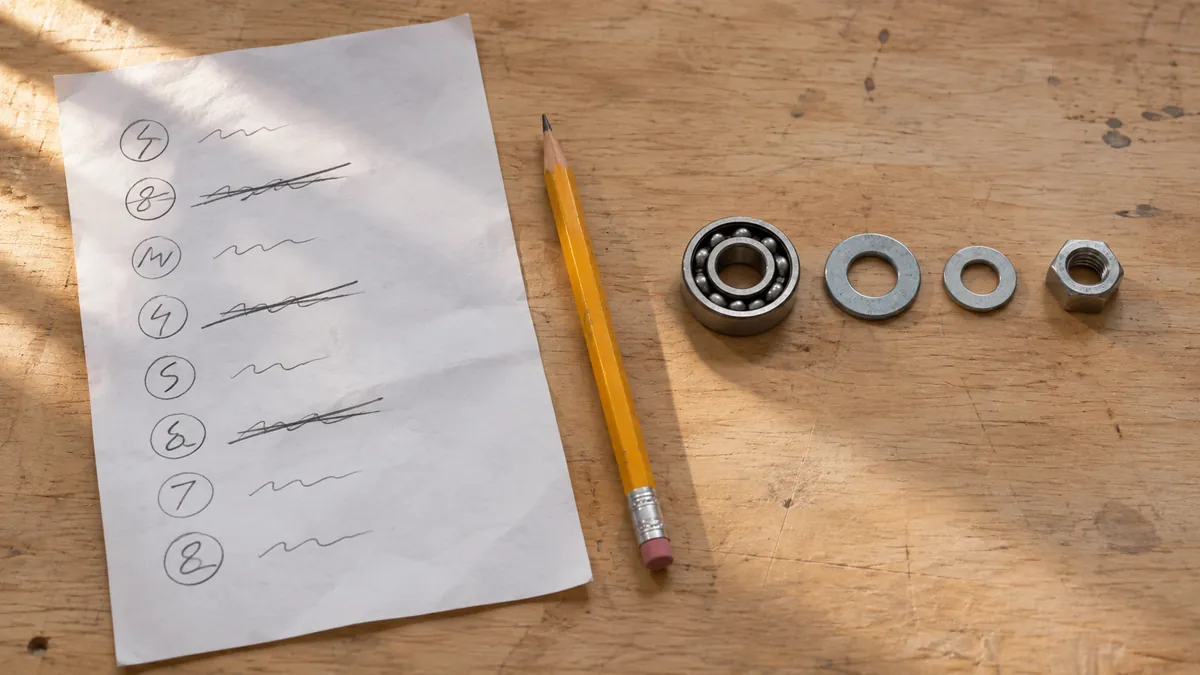
Go down the list and draw a circle beside each piece with a number inside, in the order you mean to do them. Some numbers are forced on you; the sheets have to be washed before the bed can be made. Others are a choice, and making that choice once, on paper, spares you from making it again every time you pass the spare room. The circles matter more than they seem to. They make the numbers stand apart from the words, the way callouts in a catalog drawing sit clear of the part's outline.
Try to keep a single sheet to eight or ten numbered parts. Catalog drawings follow the same discipline: when an assembly grows crowded, the draftsman opens a second sheet for one of its sub-assemblies. A day with twenty-five numbered steps is really two or three days squeezed onto one page.
Put it back together from the lowest number up
Now work the list from the smallest number upward and strike through each piece when it is finished. The stroke is not decoration. A struck line shows, at a glance, exactly where you stopped, which is the very question that goes missing when the doorbell rings mid-job. Coming back to the page after an interruption, you do not have to recall anything at all: the first circle without a line through it is where you are.
Handling one numbered piece at a time is also kinder to attention than juggling three. Studies of so-called multitasking have looked at this for years, and the recurring finding is that hopping between tasks costs time and invites slips. A numbered sheet quietly takes the hopping off the table.
Spin the wheel before you close the hood
A careful mechanic never buttons up an assembly and walks off. He spins the wheel, presses the pedal, and looks along the bench for a leftover bolt. Give your sheet the same look at the end of the day. Is every circle struck through? Is there a piece left over, something written down and skipped? Copy it onto tomorrow's sheet with a fresh number instead of letting it rattle around your head overnight.
When a part will not fit today
Some days a piece simply refuses to go on: the store is out of filters, the office closed at noon. In a catalog, a part that is temporarily unavailable gets a short note in the margin. Do the same thing. Pencil a few words beside the circle, "out of stock, try Thursday," and move on to the next number. The note holds the reminder for you, and the rest of the sequence does not have to sit idle waiting for one stubborn washer.
A worked example: the Saturday with too much in it
Picture a Saturday that began as a single heavy thought: "the yard, the grandkids coming over, and the pharmacy." Written as one top line and then pulled apart, it turned into eight parts. One, pick up the prescription before noon. Two, buy juice boxes on that same trip. Three, rake the front beds. Four, bag the leaves. Five, set the folding chairs out on the porch. Six, dig the board game out of the hall closet. Seven, call to confirm the time. Eight, hang the rake back up in the garage.
Drawn that way, the morning had an obvious route. The pharmacy and the juice boxes shared one trip in the car. The rake went back last on purpose, so it would not spend the night on the lawn. By two o'clock the sheet was struck through from top to bottom, and the afternoon belonged entirely to the visit.
None of this is clever, and that is its strength. A sheet of paper does not get tired, does not lose its place and never needs reminding. It simply holds the parts in order while you do the work, one circle at a time.